 How-to
How to Choose a Double-Threaded Warm Roof Screw
Last Updated: 23 November 2026
Quick Summary
A double-threaded screw is built to hold two timber layers apart with insulation between them, without crushing that insulation. Its lower thread anchors into the rafter, the smooth middle passes through the insulation, and the upper thread holds the counter batten in position. Confirm screw length and thread positions against your roof build-up before buying.
- The lower thread anchors into the rafter or joist below the insulation.
- The smooth middle section passes through the insulation layer without tearing it.
- The upper thread grips the counter batten and holds its position above the structure.
- Plywood decks need checking, as thin sheet material may not suit the upper thread.
- Stop driving once the batten is held firm, so the insulation is not compressed.
Table of Contents
- Why a Double-Threaded Screw Exists
- How Each Section of a Double-Threaded Screw Works
- Why an Ordinary Long Screw Falls Short
- Using Double-Threaded Screws in Timber Frame and Plywood Decks
- Installing Your Screws Correctly and Checking Suitability Before You Buy
- Frequently Asked Questions
Why a Double-Threaded Screw Exists
A double-threaded screw is built to hold two pieces of timber apart with insulation sandwiched between them, and to do it without crushing that insulation. In a warm roof, the insulation sits between the rafter below and a counter batten above. A screw that grips both timbers at once keeps the layers at the correct spacing. Manufacturers often call these double-threaded warm-roof or insulation screws, and the design is aimed squarely at that job.
The key idea is simple. Each thread anchors into a different piece of timber, so the screw holds the upper layer in position rather than letting it settle onto the insulation. The right choice always depends on the roof make-up in front of you.
How Each Section of a Double-Threaded Screw Works
Each part of the screw has a separate job. Understanding those jobs makes it much easier to pick the correct product.
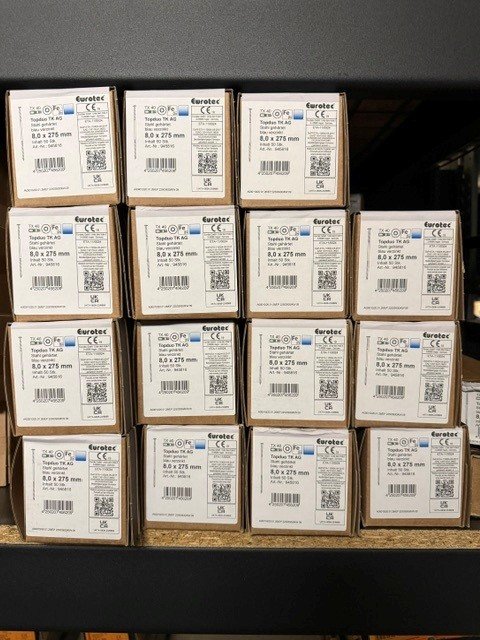
Hand holding a double-threaded screw against a timber rafter and insulation board on a roofing site.
Part of the screw | What it does |
|---|---|
Thread near the tip | Anchors into the supporting timber below the insulation, typically a rafter or joist |
Smooth middle section | Passes through the insulation layer |
Thread beneath the head | Grips the upper timber, usually a counter batten, and holds its position above the structure |
The lower thread bites into the rafter or joist and gives the screw its base. The smooth middle section passes cleanly through the insulation, so it displaces the material rather than tearing it. The upper thread then pulls the counter batten down onto the screw and keeps it fixed.
Roof loads transfer through the screws into the supporting timber. This takes some of the load off the insulation, which matters most with softer boards that compress under pressure. BS 5268 structural timber design guidance
Why an Ordinary Long Screw Falls Short
An ordinary screw with a smooth shank beneath the head tends to pull the upper timber towards the lower timber as you tighten it. With insulation between them, that pull compresses the insulation and can leave the batten sitting lower than intended.
The additional upper thread restrains that movement. It engages the counter batten directly, so tightening draws the batten into a fixed position rather than dragging it down through the insulation. A long plain screw can reach the depth, but it cannot control the upper layer in the same way.
Many installers try a long standard screw first to save money. The problem usually shows up later as an uneven roof surface or compressed insulation at the fixing points.
Using Double-Threaded Screws in Timber Frame and Plywood Decks
Timber frame and plywood decks need a closer look before you buy. The upper thread must have enough engagement in the upper timber to hold properly. As a general principle, the upper thread needs enough engagement in the counter batten or deck material to hold properly. Check the screw's design guidance for the engagement it requires.
A screw designed for a substantial counter batten should not automatically be assumed suitable for thin plywood. Thin sheet material offers less purchase for the upper thread, so the screw may not hold the layer as intended. Plywood decks also present a different load path: the upper thread grips the plywood, but the plywood itself must be thick enough to resist pull-through and to transfer the load to the counter batten or rafter. Check the thread positions and the thickness of the material you are fixing into before committing to a length. Consult the manufacturer's data sheet for the minimum substrate thickness for each screw length.
Timber frame builds vary a great deal, so treat any general rule as a starting point only. Screw length, thread positions, embedment, spacing and installation angle must suit the roof build-up and the manufacturer's design guidance. Eurotec TopDuo flanged button head product information
Always confirm the plywood thickness against the screw's specified minimum engagement before installation.
Installing Your Screws Correctly and Checking Suitability Before You Buy
Before ordering, confirm the total build-up thickness, the insulation depth and the thickness of each timber layer. Work out how far the lower thread needs to reach into the rafter, then choose a screw whose thread positions match those depths. Work out the total depth from the insulation, rafter embedment and counter batten thickness, then choose a length that matches the screw manufacturer's guidance.
Drive each screw at the angle and spacing set out in the manufacturer's guidance. For most warm-roof builds, screws are driven perpendicular to the rafters through the counter battens, following the manufacturer's design guidance. Use a correctly sized driver bit as specified by the screw manufacturer, and ensure the bit is fully seated in the head recess before applying torque.
Stop driving when the upper batten is held firm without crushing the insulation. The upper thread should pull the batten down onto the screw and hold it at the correct spacing; over-driving will compress the insulation and defeat the purpose of the double thread. If you are unsure whether a screw suits your deck or frame, check the product data sheet and compare the thread positions with your measurements. For help narrowing the options by length, diameter and drive type, contact Swiftfix Distributors Ltd.
Test the first few fixings by hand to confirm the batten is held without crushing the insulation.
Pricing depends on quantity, dates and delivery, so check current prices on the Swiftfix Distributors Ltd website or request a quote before ordering.
Getting the screw right the first time saves time and protects your insulation. If you are planning a warm roof or timber frame build and need double-threaded screws in the correct lengths, explore the Swiftfix Distributors Ltd range and check the specifications against your roof build-up before you order.
Frequently Asked Questions
What are double-threaded insulation screws used for?
Double-threaded insulation screws are used in warm roof build-ups to fix a counter batten through the insulation layer into the supporting rafter or joist. The lower thread anchors into the structural timber below the insulation, the smooth middle passes through the insulation, and the upper thread grips the counter batten above. This arrangement keeps the upper timber at the correct spacing without compressing the insulation between the two layers. It also lets roof loads pass through the screws into the structure, so the insulation is not relied upon to carry them, which matters most with softer insulation boards.
Why not just use an ordinary long screw?
An ordinary screw with a smooth shank beneath the head tends to draw the upper timber down towards the lower timber as it is tightened. With insulation sitting between them, this compresses the insulation and can reduce its performance. The additional upper thread on a double-threaded screw restrains that movement, so the counter batten stays where it was set. Choosing a screw designed for this job is a practical way to avoid compressed insulation and an uneven roof surface.
Can double-threaded screws be used on plywood decks?
Check the specific screw before using it on plywood. The upper thread needs enough engagement in the upper timber to work properly, and a screw designed for a substantial counter batten is not automatically suitable for thin plywood. Screw length, thread positions, embedment depth, spacing and installation angle must all suit the roof build-up and the manufacturer's design guidance. If the build-up is unusual, confirm the fixing details with the manufacturer before ordering in bulk.
How do I install a double-threaded screw correctly?
Follow the manufacturer's design guidance for spacing, embedment and installation angle, and drive the screw so the upper timber is drawn to its set position without crushing the insulation. Check that the lower thread has bitten into the supporting timber and that the upper thread is seated in the counter batten. Use a suitable drive for the screw head and avoid overtightening, which can strip threads or damage the insulation. Keep a record of the screw length and spacing used so the fixing can be checked later.