 how-to
Where to Buy Large Diameter Bolts in the UK
Last Updated: 30 October 2026
Quick Summary
Large diameter bolts for UK construction are available from general stockists for common sizes, specialist fastener distributors for advice and deeper ranges, and manufacturers for non-standard or high-volume orders. Confirm the specification against the build-up before ordering, and ask suppliers to confirm suitability in writing.
- Specialist fastener distributors suit unusual build-ups and offer advice on thread layout and head style.
- Manufacturers handle non-standard lengths and bespoke thread positions, with longer lead times and minimum order quantities.
- Measure the full build-up, including insulation, counter batten and embedment, before requesting a quote.
- Ask for the manufacturer's declaration of performance and technical data sheet for the exact product.
- Send build-up details to the supplier and request written confirmation of suitability before placing the order.
Table of Contents
- Why Have a Dual Threaded Screw?
- Why Not Just Use an Ordinary Long Screw?
- Checking Suitability for Plywood Decks
- Specifying the Right Screw
- Frequently Asked Questions
Warm roof construction relies on getting the fixings right, and the dual-threaded screw is one of the most useful tools for the job. This guide explains what a dual-threaded warm-roof screw does and why it matters on a UK roof build-up.
Why Have a Dual Threaded Screw?
A dual-threaded screw is a fixing with a thread at each end of the shank, separated by a smooth section. In a warm roof, the two threads grip the timber on either side of the insulation. This holds the upper timber at the correct spacing without crushing the insulation between them.
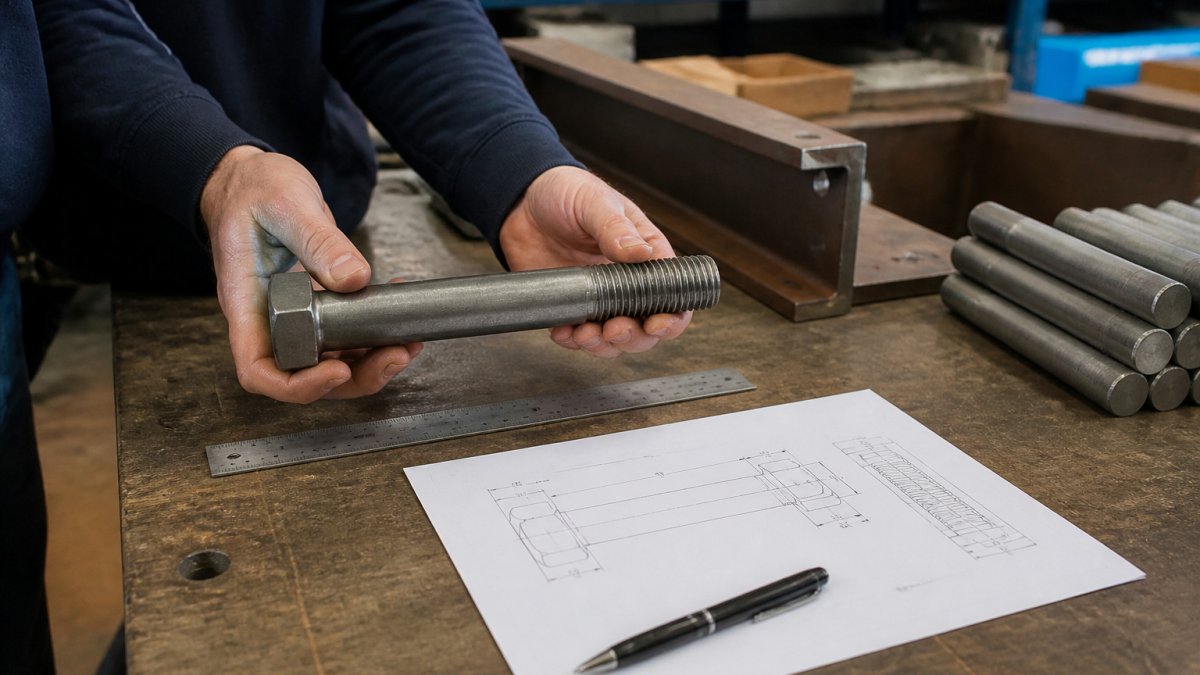
Each part of the screw does a different job:
| Part of the screw | What it does |
|---|---|
| Thread near the tip | Anchors into the supporting timber below the insulation, typically a rafter or joist |
| Smooth middle section | Passes through the insulation layer |
| Thread beneath the head | Grips the upper timber, usually a counter batten, and holds its position above the structure |
This arrangement lets roof loads transfer through the screws into the supporting timber. The insulation no longer has to carry those loads alone. That matters most with softer insulation, which can compress under pressure and lose its performance over time.
Why Not Just Use an Ordinary Long Screw?
An ordinary screw with a smooth shank beneath the head pulls the upper timber down towards the lower timber as you tighten it. With insulation sandwiched between them, that pull compresses the insulation. The second thread beneath the head restrains that movement, so the counter batten stays where it should.
This is the practical difference. A long plain screw can hold the timbers together, but it does little to control how far the insulation is squeezed. The dual-threaded design addresses both problems in one fixing.
Checking Suitability for Plywood Decks
Plywood decks are a common place where dual-threaded screws need careful checking. The principle is simple: the upper thread has to bite into enough timber to hold the counter batten in position. A screw designed for a substantial counter batten may have a thread layout that assumes a deep section of timber beneath the head. Thin plywood does not offer that depth, so the upper thread may have little to grip.
What engagement actually means
The upper thread does its job by cutting into the upper timber and resisting the pull that would otherwise close the gap between the two timbers. If the plywood is thinner than the threaded section beneath the head, part of that thread sits in air rather than timber. The fixing then behaves more like an ordinary long screw: it holds the layers together but does little to control the spacing. In that situation the insulation can still be compressed as the screw is tightened.
Checks before you commit
Work through the following against the manufacturer's design guidance for the specific product:
- Upper timber thickness. Confirm the plywood or counter batten is deep enough for the upper thread to engage fully.
- Thread position. Check where the upper thread starts and ends relative to the head, and whether it lands entirely within the upper timber.
- Overall length. Measure the full build-up, including insulation, deck and required embedment into the rafter or joist.
- Embedment into the support. Confirm the lower thread reaches the depth specified for the supporting timber.
- Spacing and pattern. Use the fixing centres from the design, not general rules of thumb.
- Installation angle. Follow the manufacturer's guidance on drive angle and head seating; an angled or over-driven screw changes how the threads engage.
When plywood is the wrong substrate
If the plywood is too thin for the upper thread to engage properly, the answer is usually to change the build-up rather than force the fixing. Options include increasing the thickness of the upper timber, using a screw with a different thread layout designed for that deck, or reviewing the design with the manufacturer. Do not assume that a screw which works on a deep counter batten will transfer directly to a thin plywood deck, the thread layout is part of the product's design, not an incidental detail.
If you are unsure whether a particular screw suits your plywood deck, send the build-up details to the supplier and ask for written confirmation of suitability before ordering.
Specifying the Right Screw
Specification is a common source of problems on warm-roof fixing orders. A screw that looks right on a product page can be the wrong length, the wrong thread layout or the wrong grade for the build-up on your drawing. Before you request a quote, work through the checklist below and put the answers in writing. Suppliers can then quote accurately first time rather than coming back with questions.
The specification checklist
| Item | What to confirm |
|---|---|
| Diameter | The nominal screw diameter the design calls for, matched to the fixing schedule |
| Overall length | Measured against the full build-up: insulation thickness, counter batten depth and required embedment into the rafter or joist |
| Thread positions | Distance from the tip to the lower thread and from the head to the upper thread, so each thread lands in the correct timber |
| Embedment | Depth of the lower thread into the supporting timber, as set out in the manufacturer's design guidance |
| Grade and material | Whether a coated carbon steel or a stainless grade is required for the exposure conditions |
| Corrosion protection | The coating or finish specified for the roof's location and environment |
| Head style | Flanged or button head, and whether the head needs to sit flush with or above the counter batten |
| Quantity | Total fixings plus a sensible allowance for waste and breakage |
| Spacing and pattern | Fixing centres and layout from the design, not from general rules of thumb |
Standards and load suitability
Ask the supplier for the manufacturer's declaration of performance and the technical data sheet for the exact product. These should state the characteristic values the design has been based on, the intended substrate and the conditions of use. Where the roof is part of a system, insulation, membrane, deck and battens supplied together, check that the screw is approved for use within that system. A fixing that is suitable in one build-up is not automatically suitable in another, and mixing components from different systems can invalidate the manufacturer's guidance.
Where to buy: three supplier routes
The right supplier depends on what you need and how quickly you need it.
- General stockists carry common diameters and lengths off the shelf and suit straightforward jobs where the specification is already settled.
- Specialist fastener distributors hold deeper ranges of construction fixings, can advise on thread layout and head style, and are the better route when the build-up is unusual or the specification needs checking.
- Manufacturers and specialist fabricators are the route for non-standard lengths, bespoke thread positions or high volumes. Expect to supply drawings or a written specification, and expect longer lead times and minimum order quantities.
Before you place the order
Confirm the screw is intended for warm-roof or insulation applications, that its dimensions match your roof build-up and that the quantity covers the full fixing pattern. If anything is unclear, send the supplier your build-up details and ask them to confirm suitability in writing. That single step prevents most of the delays caused by wrong or short deliveries.
You can browse our range of construction fixings to compare options.
Frequently Asked Questions
What are metric bolt sizes?
Metric bolts are sized by their nominal diameter in millimetres, written as M followed by the diameter, such as M10 or M16. The figure refers to the outside diameter of the threaded shank. Length is measured from under the head to the tip, also in millimetres. When ordering, give the diameter, thread pitch, length and whether the thread is fully or partially threaded. Stating these before requesting a quote prevents a supplier from sending the wrong size, which is the most common reason a large-diameter order has to be returned.
What is a shoulder bolt?
A shoulder bolt has an unthreaded, precision-machined section, called the shoulder, between the head and the thread. The shoulder acts as a bearing or pivot surface, so the bolt can locate a part accurately while still allowing rotation or movement. Shoulder bolts are common in machinery, jigs and fabrication work where the diameter of the unthreaded section must be held to a tight tolerance. When you request one, specify the shoulder diameter and length as well as the thread size.
How do I choose the right material and grade for a large diameter bolt?
Match the material to the environment and the load. A3 or A4 stainless steel suits most exterior and marine work, with A4 (316) offering better resistance to chloride corrosion. Galvanised carbon steel is common for structural and general construction use. Silicon bronze is often chosen for marine fittings. Check the strength grade against the design calculation or engineer's specification rather than assuming a standard grade is sufficient. If the load case is unclear, ask the supplier or a structural engineer before ordering.
What measurements should I provide when ordering large diameter bolts?
Provide the nominal diameter, thread pitch, overall length, thread length, head type, material and finish. For special or made-to-order bolts, add any drawings or sketches showing hole sizes and tolerances. Note the quantity and whether you need the bolts with matching nuts and washers. Accurate measurements at the quoting stage reduce delays, because a supplier that has to query the specification will hold up processing and delivery.