 Comparison
Dual-Threaded Screws: Why Use Them on Warm Roofs?
Last Updated: 22 November 2026
Quick Summary
Dual-threaded screws have two threaded sections that grip the timber on either side of the insulation, holding the layers at the correct spacing without crushing the insulation between them. They are often called double-threaded warm-roof or insulation screws, and each thread has a different job.
- The thread near the tip anchors into the supporting timber below the insulation, typically a rafter or joist.
- The smooth middle section passes through the insulation layer.
- The thread beneath the head grips the upper timber, usually a counter batten.
- An ordinary long screw can pull the upper timber down and compress the insulation.
- Check screw length, thread positions, embedment, spacing and installation angle against the manufacturer's guidance.
Table of Contents
- Why Warm Roof Screws Have Two Threads
- Fastener Specifications and Measurements to Check Before Ordering
- Small Quantity Fasteners for One-Off Fabrication Jobs
- Frequently Asked Questions
Why Warm Roof Screws Have Two Threads
Dual-threaded screws have two separate threaded sections on one shank. On a warm roof, the two threads grip the timber on either side of the insulation, holding the layers at the correct spacing without crushing the insulation between them, often called double-threaded warm-roof or insulation screws.
Each part has a different job:
| Part of the screw | What it does |
|---|---|
| Thread near the tip | Anchors into the supporting timber below the insulation, typically a rafter or joist |
| Smooth middle section | Passes through the insulation layer |
| Thread beneath the head | Grips the upper timber, usually a counter batten, and helps maintain its position above the supporting structure |
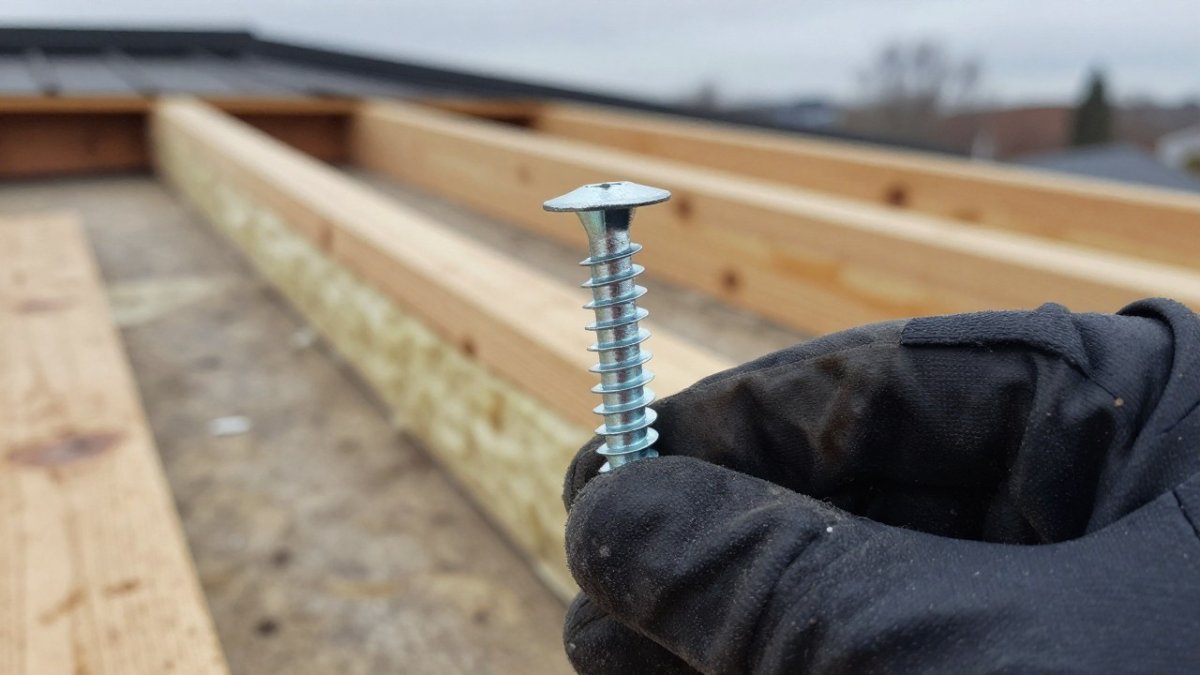
Why not just use an ordinary long screw? An ordinary screw with a smooth shank beneath the head pulls the upper timber towards the lower timber as you tighten it, compressing the insulation between. The upper thread restrains that movement.
For plywood decks, check the specific screw's suitability rather than assuming. The upper thread needs enough engagement in the upper timber, and a screw designed for a substantial counter batten is not automatically right for thin plywood. Screw length, thread positions, embedment, spacing and installation angle must suit the roof build-up and the manufacturer's design guidance.
If you are comparing fixing types for this kind of build-up, our helical flat roof fixings show how a related flat-roof fixing is specified.
Fastener Specifications and Measurements to Check Before Ordering
Ordering the right dual-threaded screws comes down to a few checks:
- Screw length: must span the insulation thickness plus enough embedment in the lower timber and engagement in the upper timber
- Thread positions: the lower and upper threads must land in the correct timber layers for your build-up
- Upper timber thickness: thin plywood engages far less thread than a deep counter batten
- Insulation thickness: confirm the actual board depth, not the nominal figure
- Manufacturer's design guidance: follow the published spacing, embedment and installation angle for that screw
Our range includes 250mm helical flat roof fixings, 195mm helical flat roof fixings and 165mm helical flat roof fixings if you want to compare lengths against your own build-up.
Watch out: a screw sized for a thick counter batten will not necessarily hold in thin plywood, because the upper thread has too little material to bite into.
Small Quantity Fasteners for One-Off Fabrication Jobs
Check the thread positions against your build-up, and keep the manufacturer's guidance on file. If you need a modest pack to finish a job, our 220mm helical flat roof fixings in packs of 25 suit small runs.
Sorting the right warm roof screw is quicker when the specification is clear and the stock is there. Swiftfix Distributors Ltd supplies construction and marine fixings in the larger sizes, longer lengths and larger diameters that standard ranges often skip, so you can match a dual-threaded screw to your roof build-up rather than compromising. Get started with Swiftfix Distributors Ltd and specify your next warm roof fixing with confidence.
Frequently Asked Questions
Can dual-threaded screws be supplied in small quantities for a one-off job?
Check the pack size before ordering, confirm the length suits your insulation depth plus batten, and keep a few spares in case of dropped or damaged screws during installation.
What information should I provide when ordering a non-standard warm roof screw?
Give the full roof build-up: insulation thickness, the type and thickness of the counter batten or deck above it, and the rafter or joist below. State the screw length, diameter, head type and the thread positions you need. For plywood decks, say so explicitly, because a screw designed for a substantial counter batten may not engage thin plywood properly. A technical specification or drawing removes guesswork and reduces the risk of a wrong-spec delivery.
How do I choose the right fastener materials and finishes for a warm roof project?
Match the material to the exposure. Confirm the coating is compatible with the timber treatment and the insulation, and check the manufacturer's design guidance for the specific build-up.