 Comparison
Hexagon Head Wood Screws - Coach Screws or Lag Screws
DIN 571 Hot Dip Galvanised Coach Screws – Heavy-Duty Timber Fixings in Sizes up to 400mm Long
When standard wood screws simply aren't big enough
When it comes to securing large timbers, heavy-duty landscaping projects or outdoor timber structures, choosing the correct fixing is essential. Standard wood screws may be suitable for everyday carpentry, but when you are working with substantial timber sections, railway sleepers or large structural components, you often need something considerably stronger and more substantial.
At Swiftfix, we specialise in supplying DIN 571 hot dip galvanised coach screws, including large diameters and extra-long lengths that can be difficult to find elsewhere.
With diameters ranging from 6mm right up to 24mm, and lengths extending to 300mm and even 400mm, our range provides fastening solutions for some of the most demanding timber applications.
What are DIN 571 coach screws?
DIN 571 coach screws, also commonly known as hexagon head wood screws or lag screws, are heavy-duty timber fixings designed to provide a secure connection into wood.
Unlike conventional wood screws, coach screws feature a substantial external hexagon head, allowing them to be tightened using a socket, spanner or suitable impact driver.
Their coarse wood thread provides effective engagement in timber, while the large diameter shank makes them suitable for applications requiring more substantial fixings.
The DIN 571 standard defines the dimensional characteristics of these traditional hexagon head wood screws.
Key features of DIN 571 coach screws
- Heavy-duty hexagon head for positive drive and effective torque transfer.
- Coarse wood thread for secure engagement in timber.
- Pointed tip to assist installation into a suitable pilot hole.
- Manufactured to DIN 571 dimensional requirements.
- Available in a wide range of diameters and lengths.
- Hot dip galvanised finish for enhanced corrosion resistance.
One of the advantages of a coach screw is that it can be installed from one side of the timber connection, without requiring access to the opposite side to fit a nut.
This is particularly useful when working with large timber posts, sleepers and existing timber structures.
Why choose hot dip galvanised coach screws?
When installing timber fixings outdoors, corrosion resistance is an important consideration.
Rain, moisture, condensation and changing weather conditions can cause ordinary steel fixings to corrode over time. Hot dip galvanised coach screws offer substantially greater protection than uncoated steel and typical thin zinc-plated finishes.
What is hot dip galvanising?
Hot dip galvanising is a process in which steel components are immersed in molten zinc. This creates a protective zinc coating that is metallurgically bonded to the surface of the steel.
The coating provides two important forms of protection:
Barrier protection: The zinc coating helps prevent moisture and oxygen from reaching the underlying steel.
Sacrificial protection: Zinc corrodes preferentially to steel, helping protect the underlying metal, including around small areas of coating damage.
This makes hot dip galvanised coach screws a popular choice for external timber construction, agricultural buildings, fencing and landscaping projects.
However, in coastal, marine, chemically aggressive or particularly wet environments, A4 316 stainless steel may be a more appropriate choice. Compatibility with preservative-treated timber should also be checked.
Our extensive range of galvanised coach screw sizes
One of the things that sets Swiftfix apart is our ability to supply large diameter and extra-long timber fixings.
Many suppliers concentrate on standard coach screw sizes, but we understand that professional contractors and timber construction specialists often require much larger fasteners.
Our hot dip galvanised DIN 571 coach screw range includes:
Diameter | Typical applications |
|---|---|
6mm | General timber fixings, smaller brackets and light-duty connections |
8mm | Timber framing, fencing and general outdoor construction |
10mm | Timber sleepers, landscaping and heavier timber connections |
12mm | Large timber posts, pergolas and substantial timber frameworks |
16mm | Heavy-duty timber connections and large timber sections |
20mm | Specialist heavy timber and industrial applications |
24mm | Extra-large timber connections and specialist construction projects |
Lengths vary depending on the diameter, with selected sizes available up to an impressive 300mm and 400mm long.
Whether you are looking for a small 6mm diameter coach screw or a substantial 20mm or 24mm diameter fixing, Swiftfix can help you source the right product for your requirements.
View our complete range of hot dip galvanised DIN 571 coach screws
Extra-long coach screws – 300mm and 400mm
Why might you need a coach screw that is 300mm or even 400mm long?
In many large timber applications, a conventional 100mm or 150mm fixing simply does not provide the required reach. Thick timbers, large posts and multiple timber sections may require a much longer screw to achieve sufficient engagement in the supporting material.
Extra-long coach screws can be particularly useful when working with:
- Large railway sleepers and landscape timbers.
- Substantial timber retaining structures.
- Heavy timber frames and oak construction.
- Large posts and beams.
- Agricultural and equestrian buildings.
- Specialist industrial timber assemblies.
- Timber bridges, boardwalks and outdoor structures, where specified by the designer.
The availability of long coach screws allows contractors to work with substantial timber sections without necessarily having to use through-bolts or threaded rod.
For engineered structural applications, the required screw length, diameter, threaded embedment and connection capacity must be determined by the project design.
Where are hot dip galvanised coach screws used?
Timber sleepers and landscaping
Coach screws are widely used in landscaping projects involving railway sleepers, raised beds, garden structures and timber edging.
Their large hexagon head provides a robust drive surface, while the coarse thread allows the fixing to engage securely with the timber.
The availability of longer lengths makes them especially useful when connecting thick sleeper sections.
Fencing and gate construction
Hot dip galvanised coach screws are an excellent option for attaching gate hinges, heavy-duty brackets and other hardware to timber fence posts.
Their corrosion-resistant finish makes them particularly suited to outdoor installations.
Pergolas, gazebos and garden structures
Building a substantial pergola or garden structure often involves securing large posts, beams and timber brackets.
Coach screws provide a traditional fastening solution, combining a substantial steel shank with a hexagon head that can be tightened securely using a socket.
Agricultural and equestrian buildings
Coach screws are frequently used for attaching brackets, rails and hardware to timber in agricultural settings.
However, where fixings are exposed to animal waste, ammonia or other aggressive substances, the suitability of the galvanised coating should be assessed carefully.
Heavy timber and specialist construction
For contractors working with large timber sections, our 16mm, 20mm and 24mm diameter coach screws offer options beyond the standard ranges found in most builders' merchants.
These larger fixings are particularly useful when a project calls for traditional hexagon head wood screws in substantial diameters or unusual lengths.
Coach screws vs coach bolts – what is the difference?
Coach screws and coach bolts are sometimes confused, but they are two very different fasteners.
A coach screw (DIN 571) features a hexagon head, a coarse wood thread and a pointed end. It screws directly into timber and does not normally require a nut.
A coach bolt (DIN 603) typically features a round head with a square neck underneath, a machine thread and a nut. It passes through the materials being connected, allowing the assembly to be tightened from the opposite side.
Feature | DIN 571 Coach Screw | DIN 603 Coach Bolt |
|---|---|---|
Head style | Hexagon head | Round head with square neck |
Thread type | Coarse wood thread | Metric machine thread |
Requires a nut | No | Yes |
Access required | Usually one side | Normally both sides |
Installation | Screws into timber | Passes through material and is secured with a nut |
Coach screws are particularly useful where access to the back of the timber is restricted, or where installing a nut and washer on the opposite side is impractical.
How to install large diameter coach screws correctly
When installing traditional DIN 571 coach screws, especially larger diameters and longer lengths, correct preparation is essential.
Unlike many modern self-drilling structural timber screws, traditional coach screws generally require a pilot hole.
1. Select the correct diameter and length
Consider the thickness of the timber being attached, the required thread engagement and the demands of the connection.
A longer screw does not automatically provide a stronger connection. The correct threaded embedment into the supporting timber is important.
2. Drill a suitable pilot hole
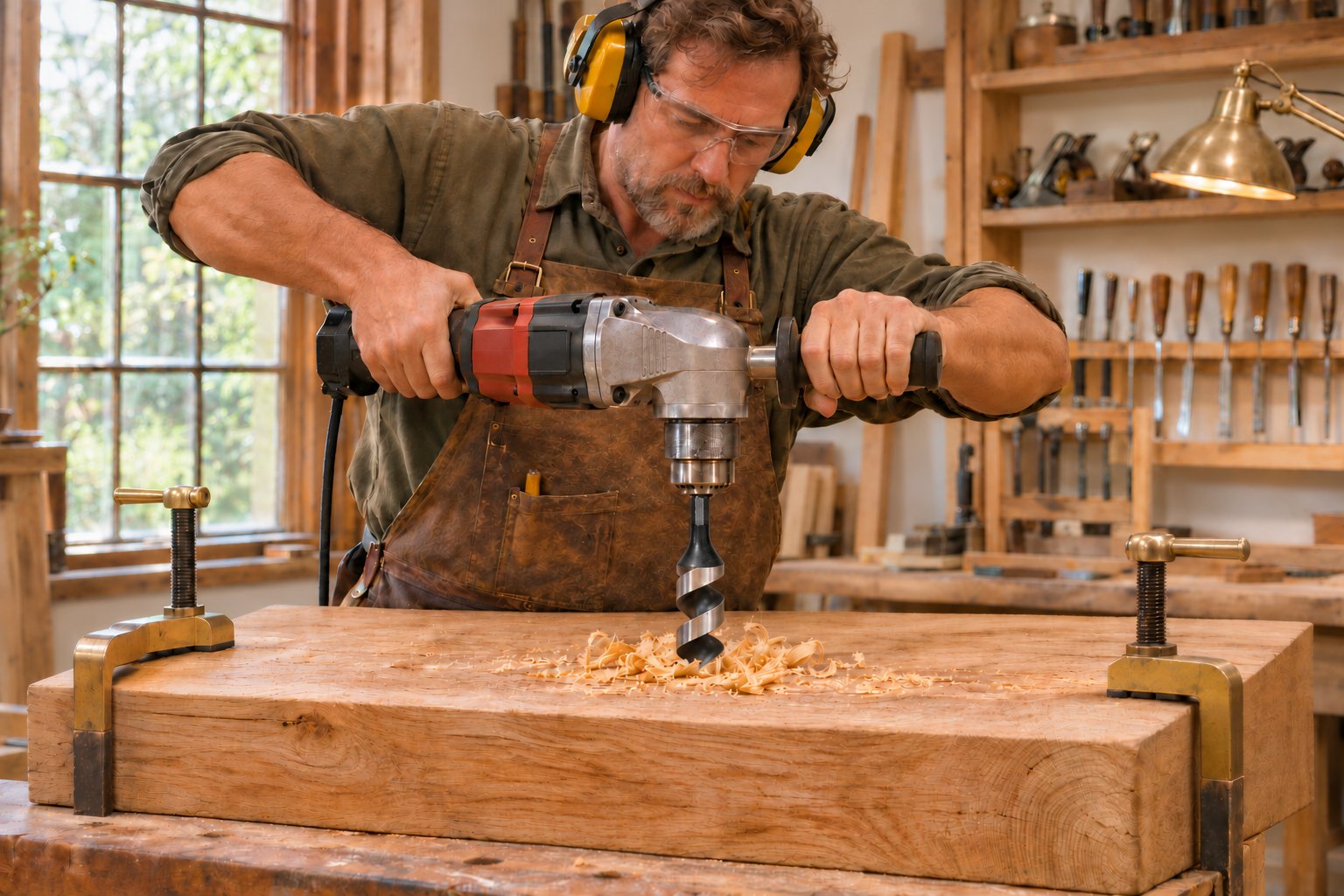
A correctly sized pilot hole helps reduce installation torque, prevents excessive stress on the screw and minimises the risk of splitting the timber.
The correct pilot hole diameter depends on the screw's core diameter, timber density and the manufacturer's installation guidance.
Hardwoods generally require more careful preparation than softwoods.
3. Use a clearance hole where required
Where two timber components are being joined, a clearance hole through the upper timber can allow the screw to pull the components together effectively.
This is particularly important when working with thick timber sections.
4. Consider using a washer
A suitable hot dip galvanised washer beneath the hexagon head helps distribute the clamping force over a larger surface area.
This can be particularly useful with softer timbers or heavy-duty connections where the head could otherwise become embedded in the wood.
5. Tighten using the correct socket
Use a correctly fitting six-point socket or spanner and tighten the screw in a controlled manner.
Avoid excessive tightening torque, particularly when installing long screws into dense timber. Over-tightening can damage the screw, crush the timber or compromise the connection.
For large diameters such as 16mm, 20mm and 24mm, accurate drilling and correct installation procedures are particularly important.
Hot dip galvanised or stainless steel – which should you choose?
Both hot dip galvanised and stainless steel coach screws have important applications in timber construction.
Hot dip galvanised coach screws are often an economical and durable option for general outdoor environments. They are particularly popular for fencing, landscaping and substantial timber construction.
Stainless steel coach screws, especially A4 316 grade, provide enhanced corrosion resistance for more demanding environments, including many coastal and marine applications.
The correct choice depends on the exposure conditions, timber species, treatment chemicals and required service life.
For example, oak and other timber species containing high levels of tannins can be particularly aggressive towards certain metal fixings. Stainless steel may be preferable where long-term corrosion resistance and avoidance of staining are important.
Where to buy large diameter hot dip galvanised coach screws in the UK
Finding standard coach screws is relatively easy. Finding a supplier that specialises in large diameter coach screws, 300mm coach screws and extra-long 400mm timber fixings can be considerably more difficult.
At Swiftfix Distributors Ltd, we have over 20 years of experience supplying specialist fasteners and fixings to the construction, engineering and timber industries.
Our extensive range of DIN 571 hot dip galvanised coach screws covers diameters of:
6mm, 8mm, 10mm, 12mm, 16mm, 20mm and 24mm.
We specialise in larger sizes and longer lengths, providing customers with access to specialist fasteners that may not be readily available from traditional builders' merchants.
From our Southampton warehouse, we supply customers throughout the UK, helping tradespeople, contractors and businesses find the right fixing for their projects.
Whether you require a small quantity for an individual project or bulk quantities for commercial construction, contact our team to discuss your requirements.
Explore our hot dip galvanised coach screw range
Shop DIN 571 Hot Dip Galvanised Coach Screws – 6mm to 24mm, lengths up to 400mm
Need a specialist size?
Contact Swiftfix for product advice, pricing and availability.
Telephone: 023 8044 6644
Email: team@swiftfix.co.uk
Website: www.swiftfix.co.uk
Swiftfix – Specialists in large diameter, extra-long and hard-to-find fasteners.
Frequently Asked Questions
What size pilot hole will i need for coach screws
For DIN 571 hot dip galvanised coach screws, the correct pilot hole depends on the diameter of the screw and whether you are fixing into softwood or hardwood. Generally, the pilot hole should be approximately the core diameter of the screw (the diameter of the solid metal beneath the thread), allowing the thread to bite into the timber without putting excessive strain on the screw during installation. Recommended pilot hole sizes for DIN 571 coach screws The following is a useful guide based on approximately 70% of the nominal screw diameter for the threaded portion, consistent with traditional timber connection guidance. DIN 571 Dimensions M5-M20 in mm+1 Coach screw diameter Pilot hole for thread Clearance hole for plain shank 6mm 4mm 6mm 8mm 5.5mm 8mm 10mm 7mm 10mm 12mm 8.5mm - 10mm 12mm 16mm 11mm - 14mm 16mm 20mm 14mm - 16mm 20mm 24mm 17mm*- 20mm 24mm The 24mm size is calculated using the 70% rule. Confirm against the actual screw dimensions and manufacturer's guidance. How to drill the holes correctly Example: 12mm x 300mm coach screw If you are joining two large timber sleepers: 1. Drill a 12mm clearance hole for the unthreaded shank. 2. Drill an 8.5mm pilot hole into the supporting timber for the threaded portion. 3. Drill to the required insertion depth. 4. Fit a suitable galvanised washer under the hexagon head. 5. Tighten using a 19mm socket, avoiding excessive torque. Important for hardwood and extra-long coach screws For dense hardwoods such as oak, the pilot hole may need to be slightly larger than the recommended table size. Check the actual root diameter and carry out a trial installation. For your 16mm, 20mm and 24mm coach screws in 300mm and 400mm lengths, I would strongly recommend pre-drilling using a long wood auger bit. This will reduce installation torque, help prevent timber splitting and minimise the risk of twisting or breaking the screw. Note: DIN 571 is a dimensional standard, not a pilot-hole specification. The table is general installation guidance; for load-bearing timber connections, use the screw manufacturer's instructions and the relevant structural design requirements.