 blog
How to Choose Silicon Bronze or 316 Stainless Fasteners
Last Updated: November 2, 2026
Quick Summary
For most structural marine work, 316 stainless steel is the usual choice, as its molybdenum content improves resistance to chloride attack in seawater. Silicon bronze resists seawater well and corrodes slowly and evenly, but it is softer and has lower tensile strength, so it suits traditional or compatibility-led marine fittings. Match the marine fasteners to the load, location and surrounding metals.
- 316 stainless contains molybdenum, which improves its resistance to chloride attack over 304 grade.
- Silicon bronze corrodes slowly and evenly rather than pitting, and suits timber-bedded hardware.
- Silicon bronze is softer, so threads can strip under high torque or heavy loads.
- Stainless can still pit or crevice-corrode in stagnant water, under deposits or in tight crevices.
- When bronze and stainless touch in seawater, the more anodic metal corrodes faster; check relative sizes.
Table of Contents
- Why Fastener Material Matters in Seawater
- Silicon Bronze Marine Fasteners: Strengths and Limitations
- 316 Stainless Steel Fasteners in Seawater: Performance and Pitfalls
- Galvanic Corrosion Between Bronze and Stainless Steel
- Marine Fastener Material Selection: Choosing the Right Option for Your Build
- Frequently Asked Questions
Why Fastener Material Matters in Seawater
Choosing the wrong fastener is one of the quickest ways to lose a marine build. Seawater is highly conductive and carries salt that attacks metal, so the choice of marine fasteners matters from the outset. A fixing that looks sound on the day it goes in can show rust staining, pitting or seized threads within a few seasons.
At Swiftfix Distributors Ltd, we supply silicon bronze and 316 stainless steel fasteners for boat builders, marine engineers and refit work. Both materials resist seawater far better than plain steel. They behave differently, though, and the right choice depends on the job.
Salt is only part of the problem. Dissimilar metals in contact, crevices where water sits, and the loads on the fixing all affect how long it lasts. A good material choice reduces the risk on all three fronts.
Silicon Bronze Marine Fasteners: Strengths and Limitations
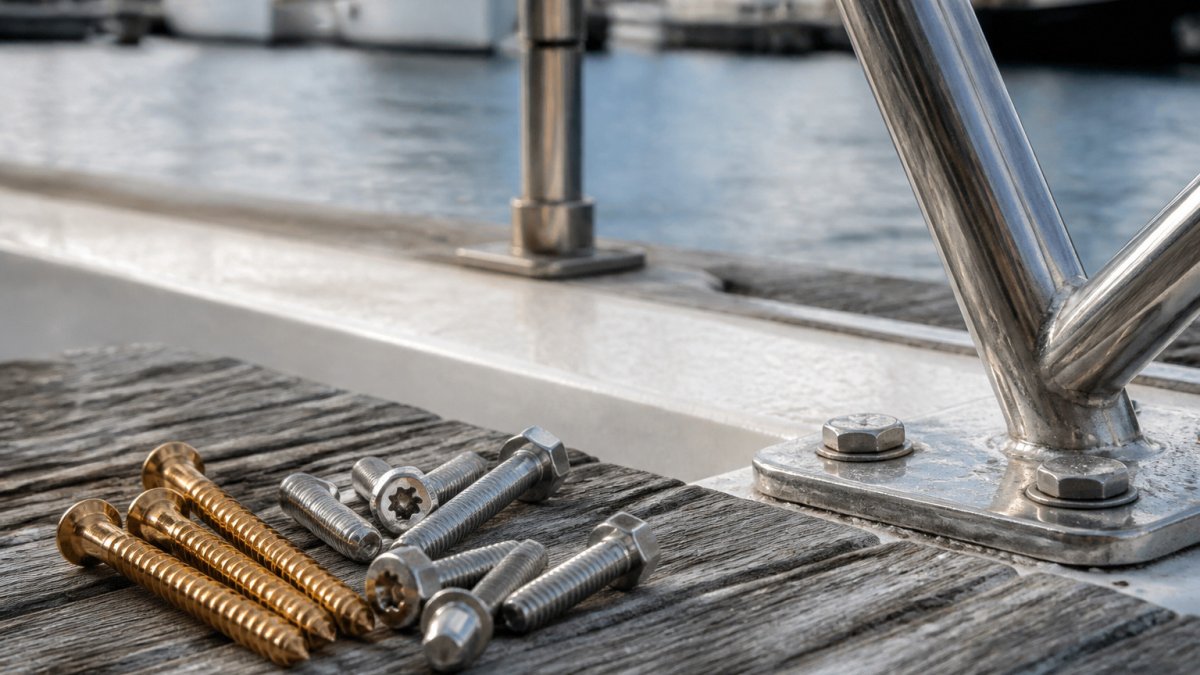
Silicon bronze is a copper alloy with silicon added. It resists seawater well and tends to corrode slowly and evenly rather than pitting. Many boat builders use it for hull and deck hardware, partly because it has a traditional look and works well with timber.
Its main strengths are:
- Good resistance to seawater and marine atmospheres
- Relatively easy to work and tap into timber
- Less prone to crevice corrosion than many stainless grades
The limitations matter just as much. Silicon bronze is softer than stainless steel, so it has lower tensile strength. Threads can strip under high torque or heavy loads, and heads can shear if the fixing is overdriven. It also costs more per fixing than stainless, so it is often reserved for locations where appearance or compatibility counts. For dry-use work where seawater exposure is not a concern, our stainless steel wire nails offer a non-marine alternative.
Watch out: do not assume a bronze screw is as strong as a stainless one of the same size. Check the load requirements before you substitute.
316 Stainless Steel Fasteners in Seawater: Performance and Pitfalls
316 stainless steel contains molybdenum, which improves its resistance to chloride attack. That is why it is the usual recommendation for marine work over the more common 304 grade. It is strong, widely available and suits most structural marine fixings.
Stainless is not immune to corrosion, however. In stagnant or oxygen-poor seawater, under deposits or in tight crevices, 316 can still pit and crevice-corrode. Fasteners that are heavily stressed or poorly installed are also more vulnerable. Surface finish matters too: scratches and contamination from carbon steel tools can start corrosion that spreads.
Practical points to watch:
- Choose genuine 316, not an unmarked stainless that may be a lower grade
- Use the same grade for nuts and washers, not just the screw
- Keep stainless away from bare carbon steel to avoid contamination
- Clean fixings after installation if they sit in salt spray
Galvanic Corrosion Between Bronze and Stainless Steel
When two different metals touch in the presence of an electrolyte such as seawater, one becomes the anode and corrodes faster. This is galvanic corrosion. Bronze and stainless steel can both be used in marine construction, but mixing them without thought can accelerate attack on one component.
In general, stainless steel is more noble than many copper alloys, so the risk depends on which part is the sacrificial member in a given assembly. The area ratio also matters: a small anodic fixing in a large cathodic component will corrode faster than the reverse. Insulating washers, sealants and gaskets can reduce contact where the design allows it.
Our advice is simple. Before mixing bronze and stainless in one assembly, check the metals involved, their relative sizes and how the joint is kept dry. If in doubt, consult the boat or structure designer.
Marine Fastener Material Selection: Choosing the Right Option for Your Build
Start with the load and the location. For structural joints under high load, 316 stainless is usually the stronger choice. For traditional fittings, timber-bedded hardware and areas where bronze is specified, silicon bronze can be the better match.
Consider these questions:
- How heavy is the load, and what shear and tensile forces act on the fixing?
- Is the fixing submerged, in splash zones, or in a dry interior?
- Will it contact other metals, and what is their relative size?
- Does the design or original specification call for a particular material?
Our pick for most structural marine work is 316 stainless, with silicon bronze reserved for specific traditional or compatibility needs. Whichever you choose, buy from a supplier who can confirm the grade and size. Swiftfix Distributors Ltd stocks a range of marine and construction fixings, including larger diameters and longer lengths. For current prices and availability, check our website or request a quote, as pricing depends on quantity, dates and delivery.
Frequently Asked Questions
Is silicon bronze better than 316 stainless steel for marine fasteners?
Neither material is universally better. Silicon bronze performs well in seawater and resists crevice corrosion, and it is generally easier to work with when fabricating custom fittings. 316 stainless steel offers higher tensile strength and is widely available in a broad range of lengths and diameters. The right choice depends on the load the fastener carries, the environment it sits in, and whether it will contact other metals. For critical structural joints, check the strength figures against the design specification before deciding.
Do silicon bronze and 316 stainless fasteners cause galvanic corrosion?
They can. Both are relatively noble metals, but they sit at different points in the galvanic series, so a potential difference exists when they are electrically connected in seawater. The more active metal corrodes faster when the two are joined. Reduce the risk by using insulating washers or sleeves, keeping the metals dry where possible, and choosing a fastener metal that matches the fitting it secures. Good design and isolation matter more than the choice of fastener alone.
Can silicon bronze fasteners be used with stainless steel fittings?
Yes, provided you account for galvanic behaviour. Fastening stainless steel fittings with silicon bronze is a common marine practice, but the joint should be kept dry and insulated where the metals meet. Use isolating gaskets, bedding compound that excludes water, and avoid leaving bare metal contact in bilge or splash zones. Check that the bolt length and thread engagement suit the fitting thickness before installation.
How do you prevent crevice corrosion in 316 stainless fasteners?
Crevice corrosion starts where oxygen and chloride-rich water are trapped between surfaces, such as under washers or inside threaded holes. Prevent it by avoiding stagnant water traps, keeping faying surfaces sealed with a suitable marine sealant, and rinsing salt deposits off with fresh water after use. Use a clean, correctly sized hole so the thread is not damaged during installation, and inspect joints regularly for staining or pitting.