 blog
Why a Dual Threaded Warm Roof Screw Beats a Plain Long Screw
Last Updated: 6 November 2026
Quick Summary
Warm roof screws, also called double-threaded warm-roof or insulation screws, grip timber on either side of the insulation, holding it at the correct spacing without crushing it. Their smooth middle section passes through the insulation, so the screw carries roof loads rather than the insulation.
- The thread near the tip anchors into the rafter or joist below the insulation.
- The thread beneath the head grips the upper timber, usually a counter batten.
- An ordinary smooth-shank screw can pull the upper timber down and compress the insulation.
- Plywood decks need checking, as a screw built for a thick counter batten may not suit thin plywood.
Table of Contents
- What a Dual Threaded Warm Roof Screw Does
- How Each Thread and Section Does Its Job
- Why an Ordinary Long Screw Falls Short
- Marine-Grade Screws and Fixings for Specialist Projects
- Checking Suitability for Plywood Decks
- Choosing a Marine Fasteners Supplier and Checking Delivery Times
- Marine Engineering Fixings Checklist Before You Order
- Frequently Asked Questions
What a Dual Threaded Warm Roof Screw Does
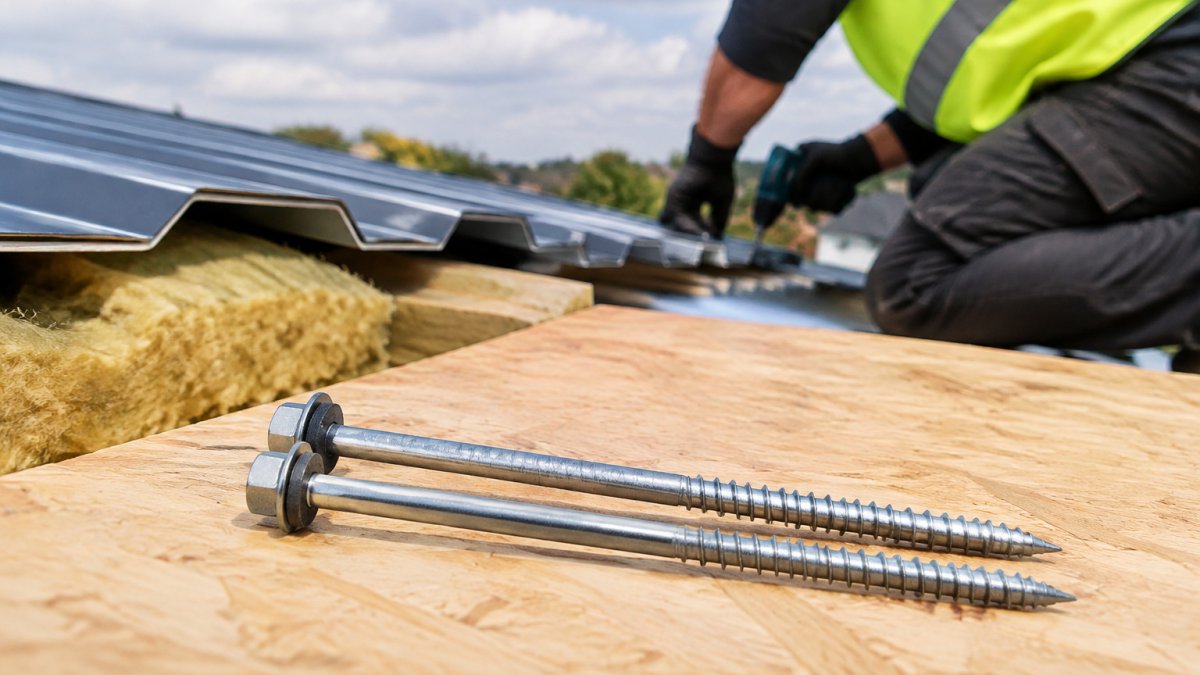
Warm roof screws, sometimes called double-threaded warm-roof or insulation screws, are designed to hold a roof build-up together without crushing the insulation layer. Their two threads grip the timber on either side of the insulation, which helps keep the upper timber at the correct spacing above the supporting structure.
The problem they solve is simple to describe. In a warm roof, insulation sits between two layers of timber, and the fixing has to pass through it. A standard screw can pull those layers together and squeeze the insulation. A dual threaded design gives the fixing a way to anchor at both ends of the build-up instead.
How Each Thread and Section Does Its Job
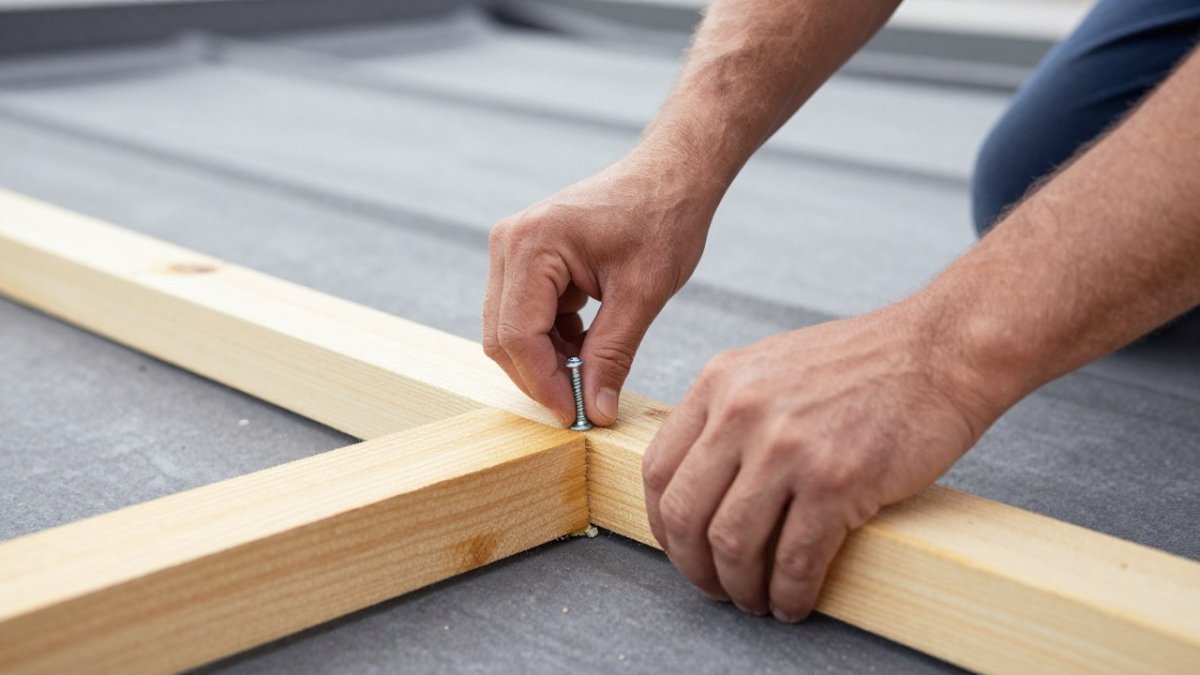
Each part of the screw has a different job. The insulation washer data sheet shows how washers used with screws help prevent thermal bridging. The thread near the tip anchors into the supporting timber below the insulation, typically a rafter or joist. The smooth middle section passes through the insulation layer without gripping it. The thread beneath the head grips the upper timber, usually a counter batten, and helps it stay in position above the structure.
Here is how the sections divide the work:
| Screw section | Main job | Timber it grips |
|---|---|---|
| Thread near the tip | Anchors the fixing | Supporting rafter or joist |
| Smooth middle section | Passes through insulation | None (clears the insulation) |
| Thread beneath the head | Holds the upper timber in place | Counter batten |
This arrangement lets roof loads pass through the screws into the supporting timber. That matters most with softer insulation, which can compress under pressure. When the screw carries the load, the insulation does not have to.
Why an Ordinary Long Screw Falls Short
An ordinary screw with a smooth shank beneath the head tends to pull the upper timber towards the lower timber as you tighten it. With insulation between them, that pull can compress the insulation and change the spacing you intended. The additional upper thread helps restrain that movement.
The difference is most noticeable in the details. Compression under a plain screw head, uneven spacing across the roof, and gradual loosening over time are all common reasons to specify a dedicated warm roof fixing instead.
Marine-Grade Screws and Fixings for Specialist Projects
Some warm roof and flat roof projects sit close to the sea, and the fixings need to resist corrosion accordingly. This is the point where a general merchant's range usually runs out and a specialist fixings supplier earns its place, because the difference between a screw that lasts and one that fails is a material specification, not a product description.
What 'marine grade' actually means for a fixing
In practice, marine-grade stainless steel means an austenitic grade with molybdenum in the alloy, and the grade most often specified for coastal and vessel-adjacent work is 1.4401 (the EN 10088 designation for 316) or its low-carbon variant 1.4404 (316L). The molybdenum content is what improves resistance to chloride attack, which is the mechanism that matters near the sea: salt deposits on the fixing, moisture holds the chloride against the surface, and the passive chromium oxide layer breaks down locally, producing pitting. Standard 1.4301 (304) stainless has no molybdenum addition and is noticeably more vulnerable to that pitting in salt-laden air, so it should not be substituted on the basis that it is 'also stainless'.
For warm roof screws specifically, the material question is not only the screw. The upper thread bears on a counter batten, the tip anchors into a rafter or joist, and any washer sits between the screw head and the insulation or deck. If the washer is a different grade from the screw, or is a coated steel item in a coastal build-up, the assembly's corrosion performance is set by the weakest component.
Corrosion resistance is not the same as strength
A common mistake is to assume that because a stainless fixing resists corrosion it can be treated as interchangeable with a carbon steel fixing of the same diameter. Austenitic stainless steels have different mechanical properties, and the load capacity of a fixing depends on the grade, the diameter, the thread form and the embedment into the supporting timber. Where a project's structural design has been carried out around a particular fixing, a material substitution needs to be checked against the manufacturer's declared values rather than assumed.
Watch out: mixing stainless fixings with galvanised or zinc-plated components in the same assembly can accelerate corrosion of the less noble part, particularly in a wet coastal environment, so keep the fastener family consistent through the build-up.
Documentation to ask for before you order
For marine and coastal projects, the paperwork matters as much as the product. Ask the supplier for:
- The declared steel grade and its standard designation, so you can confirm it against the specification rather than a trade name
- The manufacturer's datasheet covering diameters, lengths, thread positions and declared load values
- A declaration of performance or equivalent conformity documentation where the fixing is covered by a harmonised standard
- Confirmation of the coating or finish on any non-stainless component in the assembly
- Batch traceability, where the project's quality regime requires it
If a supplier cannot state the grade in standard terms, that is a signal to look elsewhere, because 'marine grade' on its own is a marketing phrase rather than a specification.
Matching the fixing to the substrate
Stainless self-drilling screws are used for fastening to heavy-gauge cold-formed steel, hot-rolled steel and extruded aluminium, and the drill point, thread pitch and head style need to suit the substrate. You can view marine-grade stainless steel self-drilling Supertek screws designed for these substrates. A fixing that suits steel framing may not suit timber, and the reverse is also true. Check the material, head style and drive type against what you are actually fixing into before ordering.
For roofing applications where a zinc finish is acceptable, a helical flat roof fixing in a zinc-plated finish is often used for securing structural insulation boards. Confirm the coating suits the exposure level of your roof before you commit, and do not carry a zinc-plated specification into a coastal detail simply because it was used on an inland one.
Manufacturer's product page for the flanged button head warm roof screw
Checking Suitability for Plywood Decks
For plywood decks, check that the specific screw is suitable. The upper thread needs sufficient engagement in the upper timber. A screw designed for a substantial counter batten should not automatically be assumed suitable for thin plywood.
Screw length, thread positions, embedment depth, spacing and installation angle must all suit the roof build-up. Follow the manufacturer's design guidance for the fixing you choose. Many warm roof fixings are designed with a specific deck thickness in mind, so the datasheet is the place to confirm whether your plywood qualifies.
Choosing a Marine Fasteners Supplier and Checking Delivery Times
The ranking pages for this kind of query are mostly merchant branch listings, so they answer 'where can I get it' and 'when will it arrive' far better than a general article does. If you are looking for an alternative to a general merchant, the comparison has to be made on the things that actually decide whether a job runs: range depth, stock certainty, lead time and account terms.
Compare suppliers on fit, not on price alone
A structured comparison is more useful than a list of names. Score each candidate supplier against the same criteria:
| Criterion | What to check | Why it matters on a marine job |
|---|---|---|
| Range depth | Sizes, lengths, diameters and material grades held as standard | Specialist lengths and stainless grades are the hardest items to source at short notice |
| Stock certainty | Whether the exact item and length is in stock, not just the product family | A near-match substitution can change the structural or corrosion performance |
| Material documentation | Grade stated in standard terms, datasheets, conformity documentation | Needed for specification sign-off and project records |
| Lead time | Dispatch cut-off, delivery window and whether partial deliveries are possible | Urgent refit and maintenance work rarely waits for a weekly delivery run |
| Delivery location | Whether the supplier delivers to ports, yards and sites, and any restrictions | Marine work is often away from a standard trade counter address |
| Account terms | Trade account availability, minimum order values and credit terms | Affects how you buy across a project rather than job by job |
| Substitution risk | Whether an equivalent is offered and how the equivalence is justified | The cost of a wrong substitution usually exceeds any unit-price saving |
Stock certainty and lead time
Ask for stock availability on the exact item and length you need, not just the product family. A supplier that can confirm stock before you order saves time when a job has to move forward, and a written confirmation is worth more than a verbal one on a time-critical refit.
Confirm how orders are dispatched, what the cut-off time is, and whether partial deliveries are possible. On a project where the counter battens arrive before the fixings, a partial delivery can keep a crew working rather than standing. If the work is at a port or yard, check the delivery address and any access restrictions before the order is placed, because a failed delivery costs a day.
Watch out: a quoted lead time that assumes stock on the shelf can slip badly if the item is on backorder, so ask specifically whether the lead time is from stock or from the manufacturer.
Account terms and the real cost of a substitution
Unit price is the easiest thing to compare and usually the least important. What matters across a project is the total cost of getting the right fixing to site on time: the trade account terms, any minimum order value, the delivery charge to your location, and the cost of rework if a substitute turns out to be unsuitable. A cheaper fixing that has to be replaced, or that fails a specification check, is the most expensive option on the list.
Ask prospective suppliers how they handle a like-for-like substitution, and whether they will confirm the grade, dimensions and declared values of the alternative in writing. A supplier that treats substitution as a conversation rather than a swap is easier to work with on a specification-led job.
What a specialist fixings supplier adds
Swiftfix Distributors Ltd specialises in larger sizes, longer lengths and larger diameters of screws and fasteners. For current availability and a quote, contact us directly, as pricing depends on quantity, dates and delivery.
Before you commit to any supplier, run the build-up past them: insulation thickness, deck material and thickness, counter batten size, exposure conditions and the required material grade. A supplier who can answer those questions against a datasheet is the one worth keeping on the account.
Marine Engineering Fixings Checklist Before You Order
Use this checklist before placing an order for warm roof or marine-grade fixings:
- Confirm the screw length against the full build-up, including insulation and counter batten
- Check the thread positions and whether both threads engage the correct timber
- Verify the deck material and thickness, especially for plywood
- Confirm the material grade, such as 316 stainless steel, for corrosive environments
- Check the head style and drive type against your tools
- Note the required quantity and spacing, including allowance for waste
- Confirm stock availability and expected delivery date for the exact item
- Check whether washers are needed to reduce thermal bridging
- Keep the manufacturer's datasheet with your project records
Getting these details right before you order keeps the job moving. If you are unsure whether a fixing suits your build-up, check the datasheet or speak to our team before you buy.
Frequently Asked Questions
What is a dual threaded warm roof screw?
A dual threaded warm roof screw has one thread near the tip that anchors into the supporting timber, a smooth middle section that passes through the insulation, and a second thread beneath the head that grips the upper timber, usually a counter batten. The two threads grip the timber on either side of the insulation, helping hold the batten at the correct spacing without crushing the insulation between them. Screws of this type are also called double-threaded warm-roof or insulation screws. They allow roof loads to transfer through the fixing into the supporting timber, so the insulation is not relied upon to carry them.
Why not use an ordinary long screw instead?
An ordinary screw with a smooth shank beneath the head tends to pull the upper timber towards the lower timber as it is tightened. With insulation sandwiched between them, that pull can compress the insulation. The additional upper thread on a dual threaded screw helps restrain that movement, keeping the batten in position above the structure. The difference matters most with softer insulation, which compresses more easily under load.
Are warm roof screws suitable for plywood decks?
Not automatically. The upper thread needs sufficient engagement in the upper timber, and a screw designed for a substantial counter batten may not suit thin plywood. Screw length, thread positions, embedment, spacing and installation angle must all suit the roof build-up and the manufacturer's design guidance. Check the product's documentation against your specific roof construction before ordering or fixing.
How should marine engineers choose fixings for a specialist project?
Start with the material and the environment. Marine projects usually call for corrosion-resistant grades such as 316 stainless steel or silicon bronze, and the specification should match the application. Confirm the required thread length, diameter and quantity before ordering. Pricing depends on quantity, dates and delivery, so request a quote from Swiftfix Distributors Ltd for current prices.