 Listicle
7 Heavy-Duty Screw Buying Checks Before You Order Online
Quick Summary
Heavy-duty screws must be chosen by their application, not just length and diameter. Check thread type, material and coating against the job, confirm embedment and corrosion resistance, and compare total cost, including delivery, before you order.
- Check thread type, material and coating before comparing prices.
- Add the material thickness to the required embedment, then allow a small margin for the point.
- Choose 316 stainless or silicon bronze for marine and corrosive environments.
- Confirm CE marking and Declaration of Performance documents for structural screws.
- Compare total cost, including delivery and minimum order quantities, not unit price alone.
Table of Contents
- Why Heavy-Duty Screws Need More Checks Than Standard Screws
- Double-Threaded Insulation Screws for Warm Roof Build-Ups
- Choosing Structural Timber Screws for Rafters and Joists
- Working Out Screw Length and Embedment
- Marine-Grade Screws: Material and Corrosion Resistance
- Drive Type, Head Style and Thread Specification
- Checking Supplier Stock, Traceability and Total Cost Before You Order
- Placing Your Next Heavy-Duty Screw Order with Swiftfix
- Frequently Asked Questions
7 Heavy-Duty Screw Buying Checks Before You Order Online
Last Updated: November 7, 2026
Heavy-duty screws look alike in a product listing, but the wrong one can fail under load, corrode in a few seasons, or simply fail to reach the timber it was meant to hold. Before you buy heavy-duty screws online, a few checks will help you avoid a wrong order and a return.
Why Heavy-Duty Screws Need More Checks Than Standard Screws
A standard screw is chosen mainly by length and diameter. A heavy-duty screw has to do more work. It may carry structural load, pass through insulation, sit in a damp or salty environment, or drive into timber that needs a deep, secure grip. Each of those demands changes the specification.
Product listings often hide these details under a generic name such as "industrial screw." Check the thread type, the material and the coating before you look at the price. A cheap screw with the wrong thread can cost more in the long run than a correctly specified one.
Double-Threaded Insulation Screws for Warm Roof Build-Ups
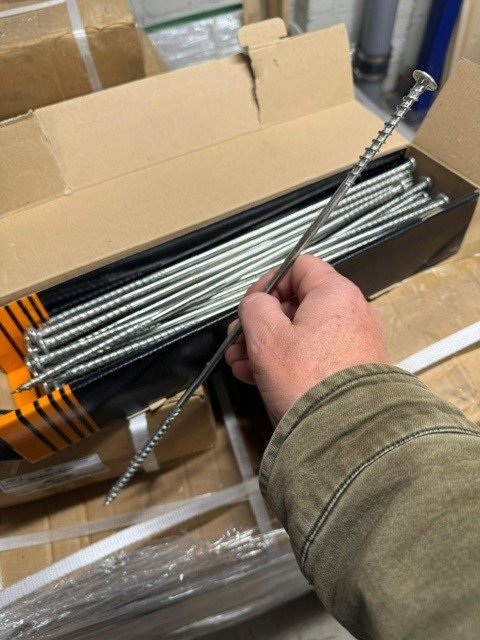
A double-threaded screw has two separate threads, and each one does a different job. The thread near the tip anchors into the supporting timber below the insulation, usually a rafter or joist. The smooth middle section passes through the insulation. The thread beneath the head grips the upper timber, typically a counter-batten, and holds it in position above the structure.

This arrangement lets roof loads pass through the screw into the supporting timber, so the insulation does not have to carry them. That matters with softer insulation, which can compress under pressure. An ordinary long screw with a smooth shank beneath the head tends to pull the upper timber down as it is tightened, squeezing the insulation. The upper thread helps restrain that movement.
Check the specific screw's suitability for your build-up. The upper thread needs enough engagement in the upper timber, so a screw designed for a substantial counter batten should not be assumed suitable for thin plywood. Confirm the length, thread positions, embedment, spacing and installation angle against the manufacturer's design guidance. Browse the Swiftfix range of hardened, weather-resistant timber fixings to match the matching screw to your build-up. Our Eurotec topduo flanged button head product page sets out the thread arrangement and intended use.
Choosing Structural Timber Screws for Rafters and Joists
Structural timber screws carry real load, so their specification should come from the design, not from habit. Start with the timber species and the connection type, then match the screw diameter and length to the fixing detail. For structural work, check that the screw is supplied with its CE marking and Declaration of Performance (DoP) documentation.
Look for screws sold for structural use and check that the listing states the intended application. Where a product page gives no load data, treat the screw as unsuitable for structural work until the manufacturer's documentation confirms otherwise. Where the design relies on a specific fixing, buy that exact product, not a near equivalent. Where available, the technical assessment for the screw will state characteristic load capacities for different timber species, diameters, and embedment depths, which should be checked against the design code.
Many buyers order a single box of one length and assume it will cover every fixing. Count the connections first, then check the quantity per box and whether the supplier offers bulk pricing for the full run. Also confirm that the screw's coating or material is compatible with the timber treatment and any membrane it will pass through. Watch out: mixing stainless screws with galvanised connectors in a damp environment can accelerate corrosion of the less noble metal.
Working Out Screw Length and Embedment
Screw length is only half the answer. What matters is embedment, which is how far the threaded part of the screw sits in the receiving timber. A screw that is long enough overall but barely bites into the lower timber will not hold as intended.
A simple way to plan is to add the thickness of the material being fixed to the required embedment in the receiving timber, then allow a small margin for the point. Check the manufacturer's minimum embedment for the chosen product, because it varies with diameter and thread type.
Avoid the common mistake of buying the longest screw available "to be safe." An overlong screw can split timber, break through the far side, or reach a service it should not touch. Work from the fixing detail, then choose the length.
Marine-Grade Screws: Material and Corrosion Resistance
Corrosion decides how long a screw lasts outdoors and at sea. Marine-grade screws are usually specified in 316 stainless steel, which resists chloride attack far better than 304 or plated carbon steel. Silicon bronze is another option for boat builders who want a traditional metal with good corrosion behaviour.
Mixing metals is a frequent cause of failure. Galvanic corrosion occurs when dissimilar metals sit in contact in a wet, salty environment, and the less noble metal corrodes faster. Match the fastener material to the metal it joins where you can, and isolate the joint where you cannot.
Be wary of listings that say "stainless" without naming the grade. Ask the supplier for the grade and, where relevant, a material certificate. Corrosion resistance is a material property, not a marketing feature.
Drive Type, Head Style and Thread Specification
The drive type affects both driving performance and how the screw resists cam-out. Torx and square drives generally hold a bit better under torque than Pozi or Phillips drives, so they suit heavy-duty work where the screw has to be driven hard. Check that you have the matching driver bits before the screws arrive.
Head style controls how the screw sits against the material. A countersunk head sits flush and suits decking or cladding that must sit level. A cap or button head bears on the surface and suits fixings where the head needs to clamp a thicker material. Flanged heads spread the load over a wider area. Choose the head to suit the fixing, not the look of the box.
Thread specification also matters. Coarse threads grip softer timber, while fine threads suit harder materials and metal. Note whether the listing gives the thread pitch and whether it is a metric or imperial thread, since the two are not interchangeable.
Checking Supplier Stock, Traceability and Total Cost Before You Order
Before you place an order, confirm three practical points: the stock is actually available, the product can be traced, and the total cost is clear. For traceability, ask the supplier whether batch numbers and material certificates are available for the screws you are considering.
Ask whether the listed quantity is in stock or on order. A product that shows as available but ships in several weeks can delay a whole project. Check the supplier's stated lead time and delivery options. Compare total cost, not unit price alone. Add delivery, minimum order quantities and any account setup, then compare the result with your current supplier. Pricing depends on quantity, the date you order and the delivery method, so check the current position on the Swiftfix website or request a quote for your exact specification.
Also consider the supplier's ability to provide technical support. A supplier who can answer questions about embedment, thread engagement, and compatibility with your build-up is more useful than one who simply lists products. Watch out: some online listings show a generic image and a vague description; always confirm the exact product code and specification before ordering, especially for structural or marine applications.
Placing Your Next Heavy-Duty Screw Order with Swiftfix
Work through the checks in order before you buy: confirm the application, work out the length and embedment, check the material and corrosion rating, match the drive and head to the fixing, then confirm stock and total cost. Keeping a short written specification for each job makes it easy to repeat the order accurately next time.
If you need a double-threaded insulation screw, a structural timber screw or a 316 stainless fixing, the Swiftfix range of timber fixings is a sensible place to start. Check each listing against your specification, and where the product details leave a question open, ask before you order. Swiftfix Distributors Ltd can help you match the right fixing to the job, and the product pages are the place to check current stock and pricing.
Frequently Asked Questions
Where can I buy heavy-duty industrial screws online?
Swiftfix Distributors Ltd supplies specialist construction and marine fixings online, including larger diameters, longer lengths and less common sizes that are often hard to find in standard ranges. Before ordering, confirm the stock listing matches the thread length, diameter and material you need, and check the delivery terms for your site. For current prices and availability, visit the Swiftfix website or request a quote, as pricing depends on quantity, dates and delivery.
How do I choose the right screw for a structural timber application?
Start with the load the fixing must carry, the timber species and thickness, and whether the screw is fixing into a solid member or a thin sheet material. Check that the screw's thread length engages sufficiently in the receiving timber, and confirm the diameter and length against the manufacturer's design guidance. Where a structural calculation or engineer's specification applies, follow that document rather than relying on general rules of thumb.
How do I calculate the screw length needed for an insulated roof build-up?
Add the thickness of the upper timber, the insulation layer and the embedment depth needed in the supporting rafter or joist, then allow for the screw head. Because thread positions differ between products, the calculation should be checked against the manufacturer's installation guidance for that specific screw. Keep in mind that a screw designed for a substantial counter-batten may not suit thin plywood, so the upper thread must still engage enough material above the insulation.
Can heavy-duty screws be used with plywood decks?
Sometimes, but only if the screw's upper thread has sufficient engagement in the plywood. A screw designed for a thick counter-batten should not automatically be assumed suitable for thin plywood. Confirm the screw length, thread positions, embedment, spacing and installation angle against the roof build-up and the manufacturer's design guidance before ordering in bulk.